 Walk for Freedom — Witton Park, Blackburn, Lancashire
The Diaspora Walks — And the Regime Listens
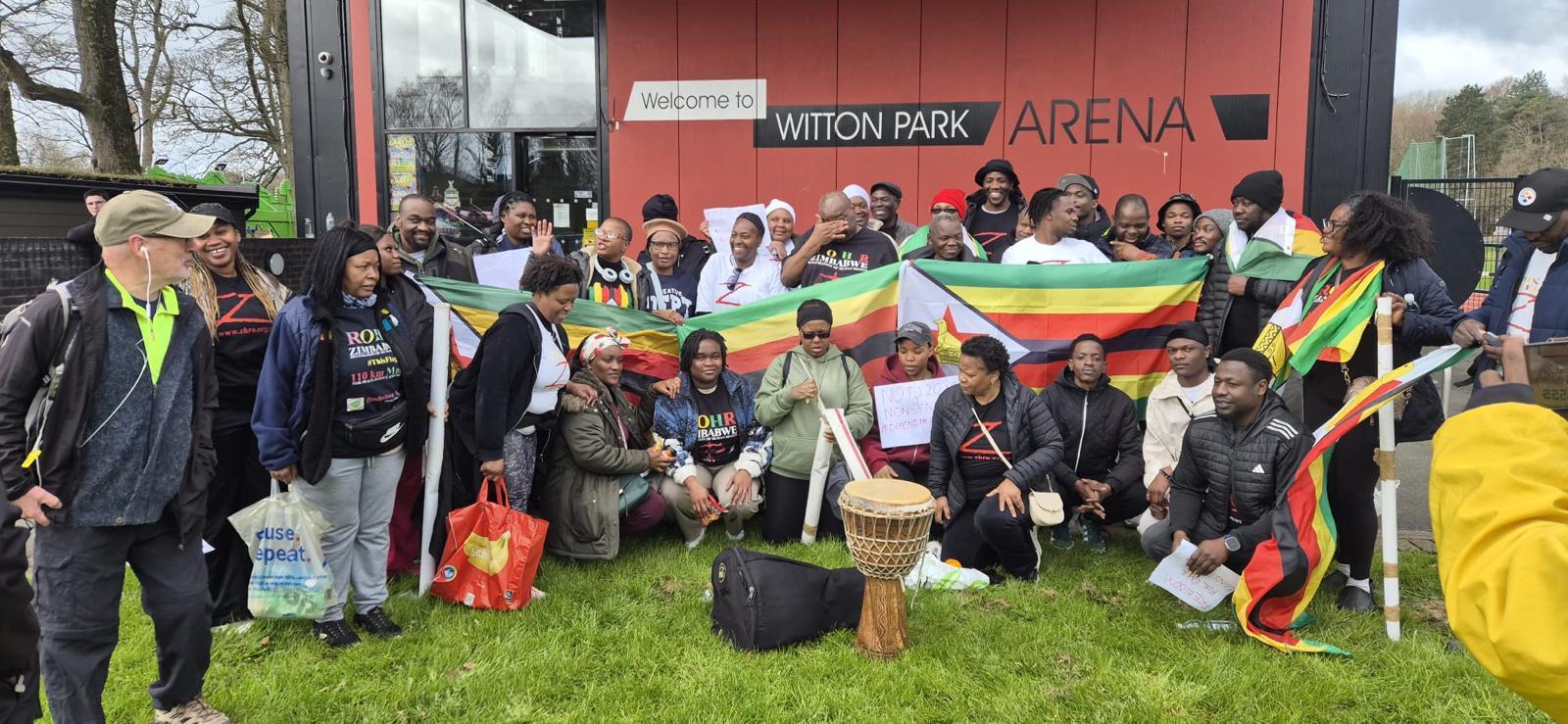
On 28th March 2026, Zimbabweans from across the United Kingdom gathered at Witton Park, Blackburn, to march peacefully against Constitutional Amendment Bill No. 3 and the Mnangagwa government’s “ED2030” agenda. What happened next revealed far more about the regime than about the marchers.
Zimbabweans across the globe have demonstrated unprecedented defiance in response to what critics describe as a tightening grip by President Emmerson Mnangagwa’s government — marked by repressive legislative manoeuvres, the deployment of state apparatus, and alleged manipulation of the ongoing constitutional amendment process.
In the United Kingdom, that defiance took the form of a Walk for Freedom: a peaceful community march held at and around Witton Park in Blackburn, Lancashire, on Saturday 28 March 2026, organised under ZHRO’s Walk for Freedom initiative. More than 60 participants — having travelled from cities across England and some even spent the previous night in nearby accommodation — braved cold and rainy/hail-stones, weather to walk together and make their voices heard.
They were not merely protesting a bill. They were speaking from lived experience. Many in the diaspora were forced to leave Zimbabwe due to prolonged political violence and economic instability, largely stemming from decades of leadership that failed to uphold accountability, transparency and good governance. For this generation, CAB3 is not a new story — it is a familiar one, with a different name at the top.
Zimbabweans in the diaspora actively participated in the COPAC process that produced the 2013 Constitution — a document built through extensive consultation, sacrifice, and collective aspiration. To see it dismantled through legislative sleight of hand is, for many, a personal wound as much as a political one.
“The recently gazetted Constitutional Amendment Bill No. 3 proposes major changes, including extending presidential terms from 5 to 7 years and allowing President Mnangagwa to remain in office until 2030. Do you support these proposed constitutional changes?”
| No, they undermine democracy | 91.84% |
| Yes, they will improve stability and governance | 8.16% |
What Is CAB3 — And Why Does It Matter?
The Constitution of Zimbabwe Amendment (No. 3) Bill 2026 — known as CAB3 — is not a routine piece of legislation. ZHRO, constitutional scholars, civic society organisations, the legal profession and church leaders have collectively described it as a “constitutional coup.” ZANU PF is actively organising nationwide campaigns to support it under the slogan “ED2030.”
- Removes citizens’ direct right to elect the President, replacing universal suffrage with parliamentary selection — by the very legislature whose legitimacy is contested following the disputed 2023 elections, whose ward-level results the Zimbabwe Electoral Commission has still never published;
- Retrospectively extends the presidential and parliamentary term from five to seven years, prolonging the current President’s tenure until 2030 without a fresh mandate from the people;
- Transfers voter registration from the independent Zimbabwe Electoral Commission to the Registrar-General, a body under direct executive control;
- Creates a new Electoral Delimitation Commission whose chairperson and members are appointed directly by the President;
- Expands the Senate by ten additional seats filled by presidential appointment.
Constitutional scholars have described the bill’s cumulative effect as a fundamental reordering of the constitutional system — increasing presidential authority while weakening mechanisms for popular participation and democratic accountability, and accelerating Zimbabwe’s ongoing trajectory of democratic regression.
When Zimbabwe enacted the 2013 Constitution, former President Robert Mugabe had been in power for 33 years. That constitution was designed, in part, to ensure Zimbabwe would never again be held hostage by a single person’s grip on power. The irony of its successive erosion under the man who removed Mugabe is not lost on anyone watching — whether from Harare or from Harlesden.
ZHRO’s Formal Response to Parliament
ZHRO submitted a detailed formal written submission to the Clerk of the Zimbabwe Parliament on 16th March 2026, opposing CAB3 in its entirety. Attached to that submission was a comprehensive Model Constitution for the Republic of Zimbabwe (February 2026 edition) — a positive alternative framework that entrenches unamendable presidential term limits, restores direct popular election of the President, establishes a fully independent Electoral Commission with mandatory international oversight, and provides robust accountability mechanisms including a Truth and Reconciliation Commission to address the Gukurahundi atrocities. In addition we produced a wide ranging web article upon this situation [CLICK HERE to READ]
Copies of the submission were sent to the UK Foreign, Commonwealth & Development Office (FCDO), the Commonwealth Secretariat, the African Union, SADC, the European Union and the United Nations Human Rights Council. ZHRO has since written directly to the Secretary of State for Foreign Affairs, the Rt Hon Yvette Cooper MP, requesting urgent diplomatic engagement in response to the regime’s surveillance of UK-based diaspora activists.
 A Diaspora Without a Vote — But Not Without a Voice
Zimbabwean citizens living in the United Kingdom have no right to vote in Zimbabwean elections. This is not accidental: it reflects a deliberate policy of exclusion of a constituency known to be broadly critical of the ruling party. In the absence of any vote, peaceful public advocacy — walking, speaking, writing — is the only democratic mechanism available to diaspora Zimbabweans.
The Zimbabwe Diaspora Vote Initiative has insisted that Zimbabweans living outside the country must participate in any constitutionally required referendum on the proposed amendments, and that excluding them would violate their constitutional rights. ZHRO fully supports that position. As the 90-day public consultation window closes and the May 2026 parliamentary vote draws near, the answer the diaspora is giving is unambiguous: No.
Voices from the Walk
“Our Walk for Freedom in Blackburn is against this amendment. If there is a need to amend the Constitution, the government should call for a referendum and seek the people’s mandate. From a military coup in 2017 to a constitutional coup in 2026 — we condemn the brutal assault of Professor Madhuku and the arrest of Tendai Biti and his team for simply opposing this bill. We are not going to stop Walking for Freedom until Zimbabwe is free. We are unstoppable.” X Post Link
“Though held in the United Kingdom, the message was clear: the struggle for democracy in Zimbabwe does not stop at its borders. Zimbabwe’s future must be built on accountability, respect for constitutional limits, and the protection of fundamental freedoms. Zimbabwe will be free — and no extension of power will silence that demand.” Full Article
“The Zimbabwean people — whether in Harare, Bulawayo, Birmingham or Johannesburg — are not passive spectators in this moment. They are witnesses, they are litigants, and they are, once again, being asked to defend a constitution they helped write. The answer they are giving is unambiguous. No.” Full Article
“I was born and raised in Zimbabwe, but growing up there was very difficult because of political problems and fear. My parents were targeted and mistreated because of political reasons. At the age of 16 I came to the United Kingdom. I march so that no child has to make that choice.” Full Article
See ZHRO's X Posts made regarding this latest Walk for Freedom X Posts for ZHRO
The Regime’s Response — And Why It Matters
Within hours of the march, the Zimbabwean regime’s response was revealing. Through unnamed “government sources” cited in the press, officials confirmed they are actively gathering intelligence on march participants, monitoring diaspora movements, and considering legal action against individuals accused of “collaborating with foreign actors” to oppose CAB3.
Organisers and participants were subjected to inaccurate and defamatory characterisations in pro-regime media — including false suggestions that ZHRO members are financially paid for their activism, and that the march was a “regime change” operation. ZHRO has issued a formal written correction and response to these claims, and reserves all legal rights in this regard.
This pattern of surveillance, delegitimisation, and threatened legal action against diaspora activists on British soil is consistent with what human rights scholars describe as transnational repression — the use by a foreign government of intelligence-gathering and legal threats to silence the lawful activities of its own nationals living abroad. ZHRO has formally raised this matter with the UK FCDO.
The Diaspora’s Demands
- Parliament must reject Constitutional Amendment Bill No. 3 in its entirety and uphold the integrity of the 2013 Constitution;
- Any constitutional amendment of this magnitude must be put to a national referendum, with full participation of the diaspora and international observers from the AU, SADC, Commonwealth, EU and UN;
- The Zimbabwe Electoral Commission must immediately publish the ward-level voting figures from the 2023 general election, withheld to this day;
- The perpetrators of violence against those opposing CAB3 — including the assault of Professor Madhuku and the arbitrary arrest of Tendai Biti and CDF members — must face accountability;
- Diaspora Zimbabweans must be enfranchised and given the right to vote in all national elections and referenda;
- The UK government must engage diplomatically to deter the Zimbabwean regime’s surveillance and intimidation of its nationals on British soil.
Walk for Freedom — A Growing Movement
The Blackburn march builds directly on ZHRO’s Walk for Freedom programme, started in 2016/17. In August 2025, ZHRO led a 105 km walk from Brighton Pier to Hampton Court, London — a bold act of kinetic protest and solidarity that drew participants from across the diaspora and attracted wide attention. That walk took place on Heroes’ Day — not by accident, but with purpose: to reclaim a day that ZANU PF has hijacked as a party propaganda tool, and return it to the people it was meant to honour.
Walking is not incidental to this movement. It is its nature. It is a form of peaceful, embodied defiance that cannot be legislated away, surveilled into silence, or dismissed as a foreign plot. Every kilometre walked is a statement: we are here, we are watching, and we will not stop.