
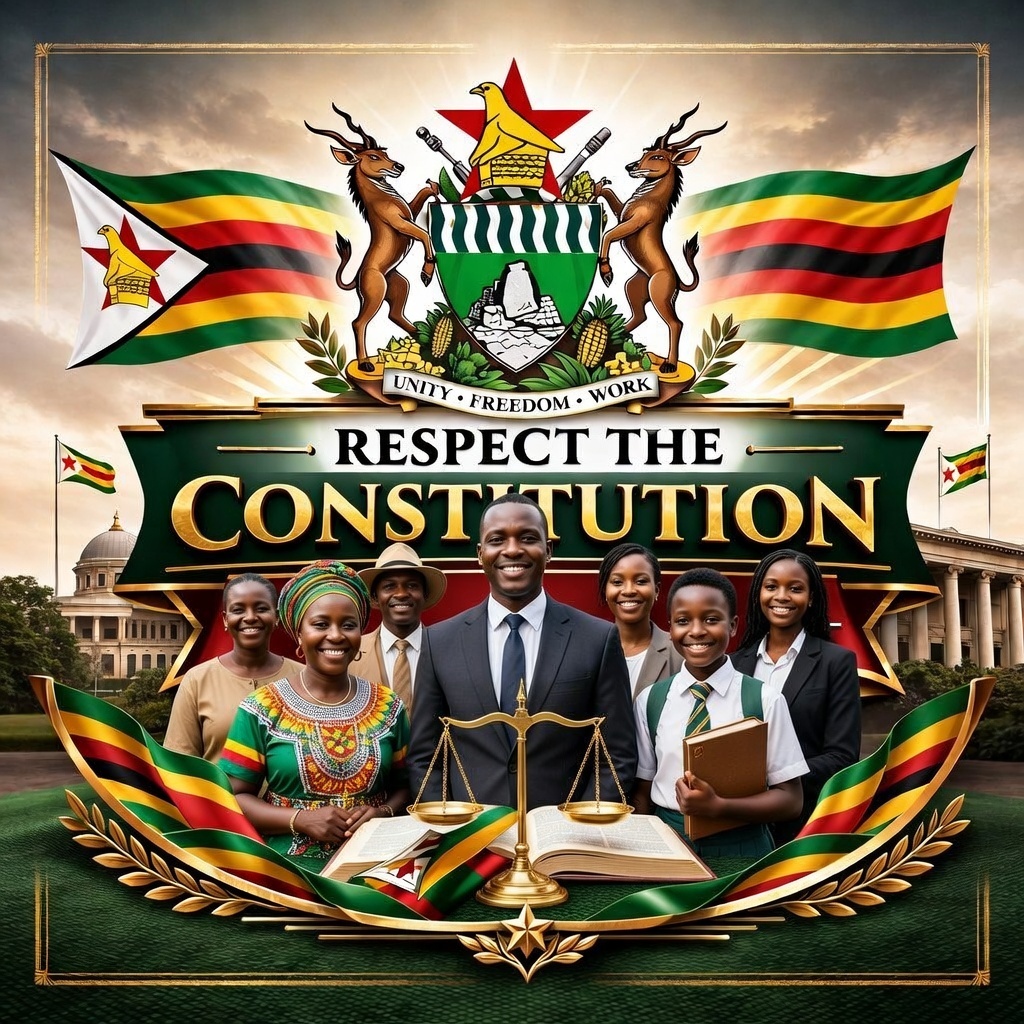
A Constitution for the People, Not the Party:
Why ZHRO's Model Constitution Must Replace Zanu PF's Stage-Managed "Public Consultation"
As Zimbabwe's Parliament prepares to debate Constitutional Amendment Bill No. 3 — a Bill designed to entrench Emmerson Mnangagwa's grip on power until 2030 and beyond — ZHRO presents a credible, democratic alternative rooted in genuine separation of powers, inviolable term limits, and the sovereignty of the Zimbabwean people.
| Former Finance Minister and Constitution Defenders Forum convener Tendai Biti appeared at Mutare Magistrates Court this morning after being arrested by armed police officers on Saturday 21 March while organising a private meeting to oppose the Constitutional Amendment Bill. Charged under the Maintenance of Peace and Order Act (MOPA) for allegedly failing to notify police of a gathering — despite the CDF's insistence that MOPA explicitly excludes private meetings from police jurisdiction — Biti's prosecution is the most high-profile act of repression yet in Zanu PF's escalating campaign to silence dissent. Amnesty International has condemned the arrests as part of an "escalating crackdown on peaceful dissent." His crime, in the words of constitutional lawyer Lovemore Madhuku: "speaking out against the Constitutional Amendment." |
Section I The Crisis: What Constitutional Amendment Bill No. 3 Actually Does
Zanu PF and its apologists have framed the Constitution of Zimbabwe Amendment (No. 3) Bill 2026 — already widely known as "ED2030" or "CAB3" — as a routine legislative reform. It is nothing of the sort. In its substance and its timing, CAB3 represents the most brazen assault on Zimbabwe's democratic architecture since independence.
- Remove the direct election of the President by the people, replacing it with election by Parliament — a Parliament itself dominated by Zanu PF through patronage, intimidation, and electoral manipulation.
- Extend both presidential and parliamentary terms from five years to seven years, giving President Mnangagwa — whose current term ends in 2028 — a potential unelected extension to 2030 and beyond.
- Weaken the independence of ZEC and the judiciary, stripping away institutional safeguards that, while imperfect, represent the last barriers to outright single-party authoritarianism.
"Any amendment extending presidential terms must be approved in a referendum — the government's position that Parliament can bypass this is constitutionally bankrupt."
Section 328, Constitution of Zimbabwe (2013)The government's position — advanced by Justice Minister Ziyambi Ziyambi — that Parliament may enact these changes without a referendum because "the two-term limit remains" is constitutionally bankrupt. Section 328 of Zimbabwe's 2013 Constitution expressly requires a referendum for any amendment that has the effect of extending a sitting president's term of office. Lengthening each term by two years while the incumbent is in office plainly has that effect. No honest reading of the provision can suggest otherwise.
This is the context in which Zanu PF has launched its "Public Consultation Process." It is also the context in which Tendai Biti sat in a Mutare police cell over the weekend.
Section II The Fraud: Zanu PF's "Public Consultation" Is Stage-Management, Not Democracy
A genuine public consultation on constitutional change requires, at minimum: freedom of assembly for opponents; equal access to state media; unrestricted civic space; and an independent body to administer the process. Zimbabwe in March 2026 has none of these.
- Police banning or disrupting meetings of constitutional opponents, while Zanu PF gatherings proceed unhindered.
- The arrest of Tendai Biti and Morgan Ncube under MOPA for holding what the CDF confirms was a private meeting exempt from notification requirements under the very Act cited.
- Law professor Lovemore Madhuku hospitalised, beaten by men he identified as police officers after a party meeting on the proposed changes.
- The arson attack on SAPES Trust offices, set ablaze hours before a scheduled press conference opposing the amendments.
- A state broadcaster that has provided no platform to the broad coalition — lawyers' associations, war veterans' groups, church bodies, and students' unions — opposed to CAB3.
It is in precisely this environment — one in which 46 years of single-party dominance have produced a consultation process designed to deliver a predetermined outcome — that ZHRO has submitted its Model Constitution as a formal contribution. We do so not because we expect Zanu PF to adopt it. We do so because the record must show that a democratic alternative exists, that Zimbabweans have articulated it with specificity and rigour, and that the international community cannot claim ignorance of what is being suppressed.
Section III The Alternative: What the ZHRO Model Constitution Provides
The ZHRO Model Constitution, published February 2026, is a detailed, article-by-article framework drawing on the separation-of-powers tradition of the United States Constitution, the parliamentary accountability principles of the UK constitutional tradition, and the specific lessons of Zimbabwe's own post-independence experience of abuse. Its key provisions address the exact pathologies that have allowed Zanu PF to hollow out Zimbabwean democracy over four and a half decades. See the FULL ZHRO Model Costitution - CLICK HERE - Note; that we have sited the New Model on the Take2Zimbabwe website because this platform espouses a NEW Independence Movement - something necessary after 46 years of governance failure by the corrupt Zanu PF regime - in power via vote rigging and maniputation of all the Institutions normally associated with a government - BUT in Zimbabwe, these all hum the Zanu PF corruption tune!
⚑ Absolutely Unamendable Term Limits
Art. II, Sec. 2: No person may serve as President for more than two five-year terms. This provision cannot be amended, revised, or replaced by any future instrument. Advocacy for amendment constitutes treason.
⚑ Direct Election by the People
Art. II, Sec. 1: The President is elected directly by universal adult suffrage. No parliament may substitute itself for the electorate. The mandate flows from the people — not from a captured legislature.
◈ Genuinely Independent Electoral Commission
Art. V: IEC composition balanced between ruling party, opposition, and civil society. No election valid without AU/Commonwealth/EU/UN observer certification. Electoral fraud: mandatory 15-year minimum sentence.
◈ Judicial Independence with Real Teeth
Art. IV: Constitutional Court empowered to strike down any law or executive action. Judges appointed through a multi-stakeholder Judicial Service Commission. All branches must implement court orders.
◈ Gukurahundi Accountability
Art. VI: Truth & Reconciliation Commission with express jurisdiction over the 1980s atrocities. No immunity for crimes against humanity, regardless of office held. Reparations Fund mandated by Parliament. Provision is itself unamendable.
◈ Anti-Corruption Architecture
Art. IX: Independent Anti-Corruption Commission with power to prosecute the President. Mandatory public asset declarations. All contracts above USD 100,000 via public tender. Whistleblower protection in law.
"The contrast with CAB3 could not be starker. Where Mnangagwa's Bill uses constitutional machinery to perpetuate personal rule, the Model Constitution uses constitutional entrenchment to make such perpetuation permanently impossible."
ZHRO, Model Constitution — Concluding Provisions, February 2026Section IV The Biti Precedent: Why This Matters to the International Community
Tendai Biti is not simply a Zimbabwean opposition politician. He is a qualified lawyer, a former Finance Minister internationally recognised for his stewardship during the 2009–2013 Government of National Unity, and the convener of the Constitution Defenders Forum — the broadest coalition assembled in Zimbabwe against a constitutional amendment since independence. His arrest on Saturday 21 March, by armed police officers, for attending a private meeting to discuss a Bill currently before Parliament, is not a law enforcement action. It is an act of political suppression.
The MOPA charge is transparently pretextual. The CDF correctly notes that MOPA expressly excludes private meetings from police notification requirements. No credible legal analysis supports the prosecution. Its purpose is singular: to remove Biti from the campaign trail at the precise moment Parliament is moving toward a vote — neutralising the most effective organiser against CAB3 during the critical consultation period.
The Democratic Alliance of South Africa has already called on President Cyril Ramaphosa to condemn the arrest and engage diplomatically. ZHRO calls on the United Kingdom Government — which maintains significant economic and diplomatic relations with Zimbabwe, and whose citizens include hundreds of thousands of Zimbabweans in diaspora — to make unambiguously clear that constitutional amendments enacted through repression, without referendum, and in violation of Section 328 of Zimbabwe's own 2013 Constitution, will not be recognised as legitimate.
Section V The Call to Action: What ZHRO Demands
To the Zimbabwean Government
- Release Tendai Biti and Morgan Ncube immediately and unconditionally, and drop all charges.
- Withdraw Constitutional Amendment Bill No. 3 from the parliamentary agenda.
- If proceeding with any constitutional amendment, comply with Section 328 and submit proposals to a genuine, independent, internationally monitored referendum.
- Cease all harassment, surveillance, and prosecution of civil society, legal professionals, journalists, and opposition figures engaged in lawful constitutional advocacy.
To the United Kingdom Government
- Publicly condemn the arrest and detention of Tendai Biti as incompatible with democratic norms.
- Formally communicate that CAB3 enacted without a referendum will not be recognised as legitimate by the United Kingdom.
- Review and, where appropriate, extend targeted sanctions against individuals responsible for the suppression of constitutional rights in Zimbabwe.
- Engage the African Union, Commonwealth Secretariat, and European Union to deliver a unified international response to the present constitutional crisis.
To the Zimbabwean Diaspora & International Civil Society
- Amplify the ZHRO Model Constitution as evidence that Zimbabweans have articulated a credible, detailed democratic alternative — and that the choice facing Zimbabwe is not between the status quo and chaos, but between Zanu PF's authoritarianism and genuine constitutional democracy.
- Attend, support, and publicise all lawful advocacy events organised in solidarity with Zimbabwe's constitutional defenders.
- Engage Members of Parliament, senators, and elected officials in your respective countries of residence to raise Zimbabwe at every diplomatic level.
Zimbabwe's 2013 Constitution — hard-won through years of negotiation, sacrifice, and international pressure — is not a perfect document. But it is the people's document. It contains term limits. It mandates direct presidential elections. It requires referenda for fundamental amendments. It is under coordinated, systematic attack by the very party that has governed — and looted — Zimbabwe for 46 years.
ZHRO's Model Constitution does not ask Zimbabwe to reinvent the wheel. It asks Zimbabwe to honour the democratic commitments already made in 2013, and to go further — to entrench them so deeply that no future regime, however powerful or persistent, can undo them without the explicit, free, and informed consent of the Zimbabwean people.
Tendai Biti is in court today for standing for that principle. ZHRO stands with him. The international community must stand with Zimbabwe.