
 Zimbabwe’s Constitutional Moment:
Why the Referendum Matters More Than CAB3 Itself
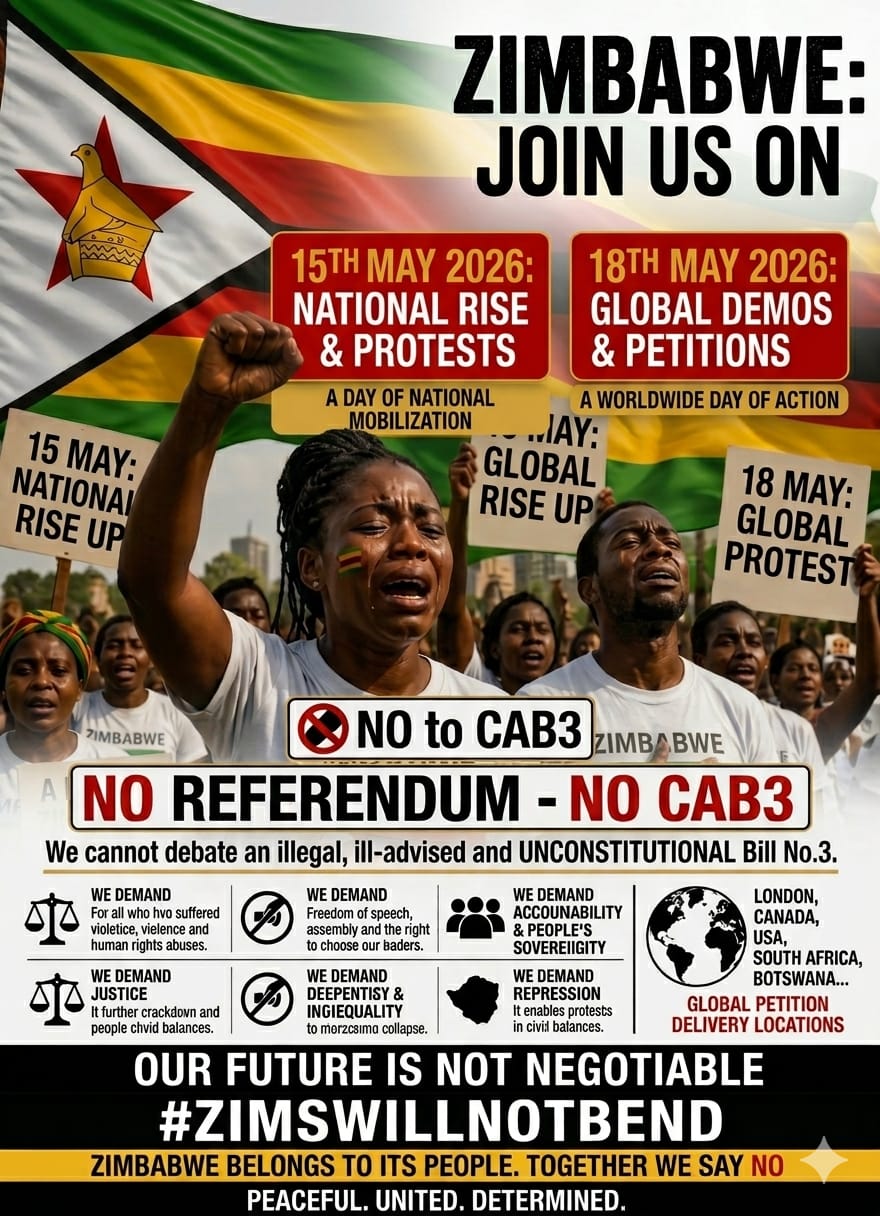
In recent weeks, public debate around Constitutional Amendment Bill No. 3 (CAB3) has intensified, drawing passionate responses from citizens both at home and across the diaspora. Protests, petitions, and calls for national mobilization reflect a growing sense that Zimbabwe stands at a defining crossroads. Yet amid all the noise, there is a critical point that must remain at the center of this conversation:
the constitutional requirement for a referendum.
This is not a technicality. It is the foundation of constitutional democracy.
The 2013 Constitution was born out of broad public consultation and national consensus. It represents the will of the people, not the preferences of those temporarily in power. Any attempt to alter that foundational document—especially in ways that may affect governance, rights, or democratic structures—demands direct public participation through a referendum. This is not optional. It is a constitutional obligation.
Efforts to redirect the conversation toward the content of CAB3—whether its provisions are beneficial or harmful—miss the point entirely. That shift is a distraction. It invites endless debate, division, and confusion, while quietly bypassing the core legal requirement that gives legitimacy to any constitutional change. Without a referendum, the process itself becomes unlawful, regardless of the arguments for or against the bill’s contents.
This is why the message from civic groups and activists has been consistent: No referendum, no legitimacy. No CAB3 without the people’s direct consent.
The demands expressed in public demonstrations and advocacy campaigns reflect deeper concerns about governance and accountability. Citizens are calling for justice for victims of violence, protection of fundamental freedoms such as speech and assembly, and an end to repression. They are demanding transparency, equality, and respect for the rule of law. These are not abstract ideals—they are the pillars of a functioning democracy.
But none of these demands can be secured if the constitutional process itself is undermined.
A government that sidesteps constitutional requirements sets a dangerous precedent. It signals that rules can be bent when inconvenient, and that power can override principle. Today it may be CAB3; tomorrow it could be other rights and protections that are quietly eroded. This is why the referendum requirement is not just about process—it is about safeguarding the future. The growing calls for national and global action—through protests, petitions, and public engagement—highlight a collective determination:
Zimbabwe belongs to its people. Decisions of this magnitude cannot and must not be made without them.
This moment demands clarity and discipline in public discourse. When speaking, advocating, or engaging with media, the focus must remain firm:
The issue is not what CAB3 says. The issue is that it cannot lawfully exist without a referendum.
That is the ground on which citizens stand. It is a position rooted not in politics, but in constitutional principle. Zimbabwe’s future is not negotiable. It must be shaped by the voices of its people, expressed freely and directly. A referendum is not a barrier—it is the very mechanism that ensures legitimacy, accountability, and national ownership of the Constitution.
Anything less risks undermining the democratic foundation on which the nation stands.