There is very little evidence of an operational Democracy in Zimbabwe, in practice. This situation has been continuing since the "first independence" registered on 18th April 1980
- Details
- Written by: Felistas and Felicia Munemo
- Hits: 41
 The Youth Must also be Activists
Know Your Politics:
Why Every Young Person Must Understand the System Before They Can Defend It.
There is a dangerous myth that politics is for old men in suits, for lawyers, for people with grey hair and long titles. Young people are told, directly or indirectly, to stay in their lane to focus on school, on hustling, on “apolitical” ambition. Meanwhile, the decisions that will shape the next fifty years of their lives are being made in parliaments, cabinets, and constitutional committees they were never taught to read.
This is not an accident. An uninformed youth is a convenient youth. A generation that does not know its constitution cannot tell when that constitution is being gutted. A generation that cannot name its representatives cannot hold them accountable. Silence is not neutrality it is surrender by default.
Democracy Dies Quietly, Not Loudly
Coups make headlines. But most erosions of democracy do not look like tanks in the street. They look like a clause quietly amended in a bill few people read. They look like an independent commission “restructured” until it has no teeth. They look like a chairperson removed through an administrative memo instead of due process. By the time the public notices, the damage is already law.
This is why civic literacy cannot be optional for young people. If you do not know what your constitution protects your right to assemble, to speak, to be governed by term limits, to have an independent judiciary you will not recognise the moment those protections are being dismantled in front of you.
What “Knowing Your Politics” Actually Means
It is not enough to know who the president is. Real political literacy means:
- Details
- Written by: Senator Jameson Timba
- Hits: 118
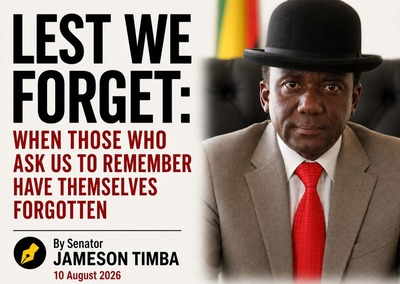 LEST WE FORGET: WHEN THOSE WHO ASK US TO REMEMBER HAVE THEMSELVES FORGOTTEN
10 August 2026
This year's National Heroes Day commemorations are being held under a particularly poignant theme:
“Lest We Forget.”
Those words are ordinarily an invitation to a nation to remember.
To remember the young men and women who abandoned schools, universities, jobs and families to join the liberation struggle. To remember those who crossed borders into uncertainty. To remember those who were imprisoned, tortured, maimed or killed. To remember those who lie in marked graves, unmarked graves and distant lands.
- But in Zimbabwe today, “Lest We Forget” carries a painful irony.
- Because the greatest danger confronting us is not that the people of Zimbabwe have forgotten.
- It is that those governing Zimbabwe appear to have forgotten.
- They have forgotten what the liberation struggle was about.
What Did They Fight For?
Our heroes did not fight merely to replace a white ruling elite with a black ruling elite.
- Details
- Written by: John Burke
- Hits: 170
 ZIMBASSY
The Embassy Zimbabweans Actually Trust
Every dictatorship needs an embassy. This one has a diaspora instead.
Walk past the Zimbabwean High Commission in any Western capital and you'll find a building. Flags, a crest, a reception desk. What you won't find is anyone inside who speaks for the millions of Zimbabweans who left because that government made staying impossible.
That's the gap ZIMBASSY fills.
Not a building. Not a bureaucracy. Not a single leader ZANU-PF's courts can capture, recall, or intimidate into silence — the way they gutted the CCC through the Tshabangu affair. ZIMBASSY is a distributed embassy: diaspora voices, documentation, and pressure, organised around the one thing Harare's embassies can never represent — the truth about what's happening back home.
While the official embassies host garden parties for Zanu-PF loyalists and process land-allocation paperwork for the party faithful, ZIMBASSY has spent 2026 doing the actual work of representing Zimbabweans abroad: documenting CAB3, Zimbabwe's attempted constitutional power-grab; recording testimony from journalists harassed for reporting it; putting the UK Parliament's own criticism of the bill on the public record; and giving diaspora voices — from Downing Street protests to personal testimony — a platform the regime cannot switch off.
The diaspora sends home an estimated $2.4 billion a year — the single largest prop under Zimbabwe's economy. In return, the government that drove them out won't even guarantee them healthcare when they visit. ZIMBASSY exists because representation should not be conditional on remittances.
This is what an embassy looks like when it belongs to the people instead of the party.
Join ZIMBASSY. Because the real Zimbabwe didn't leave — it multiplied.
- Details
- Written by: John Burke
- Hits: 345
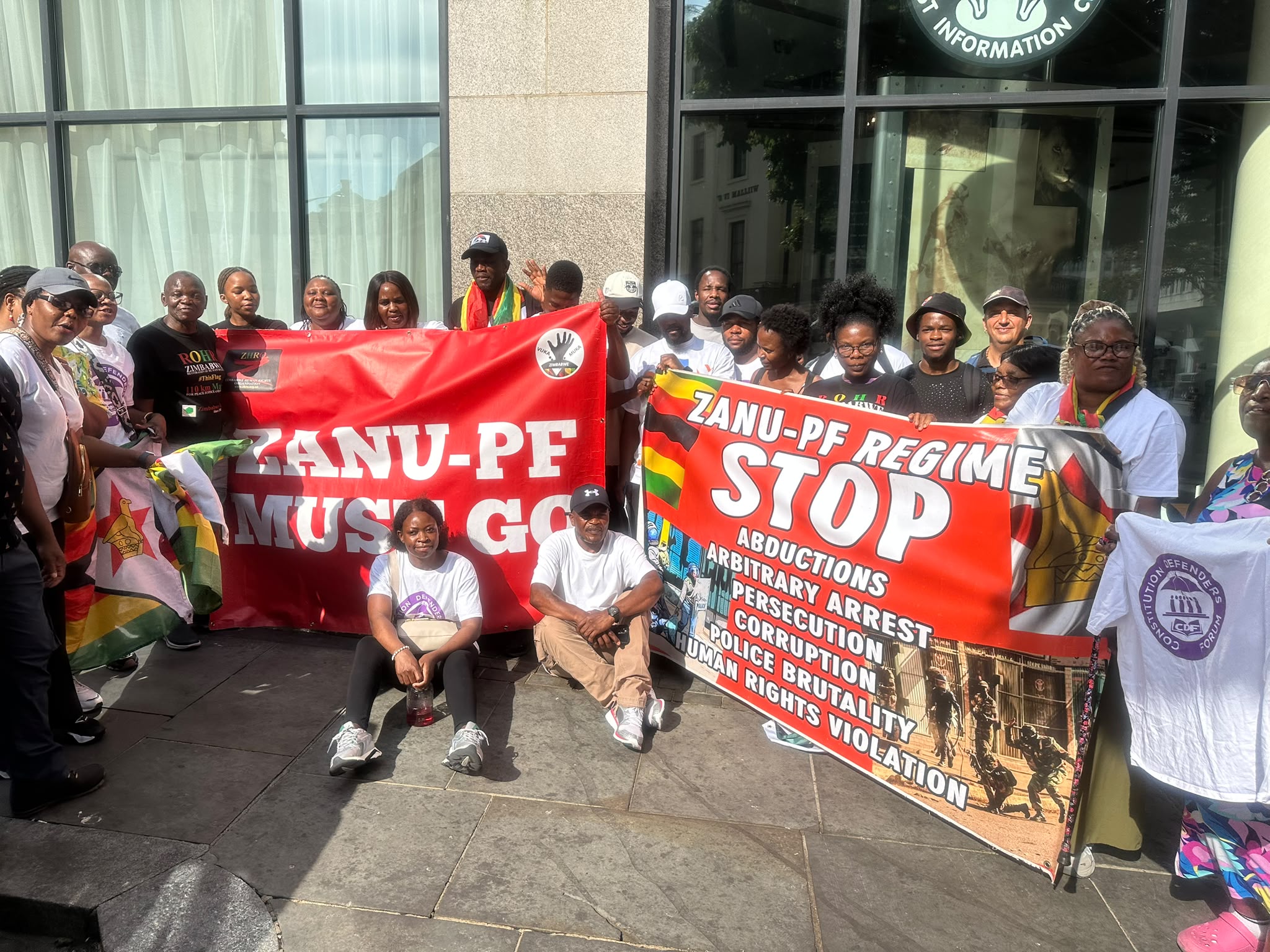 A Handshake and a Placard:
ZANU PF's "Investment Forum" Meets the [real] Diaspora at 429 The Strand
By ZHRO / Constitution Defenders Forum / ROHR — London, 10 July 2026
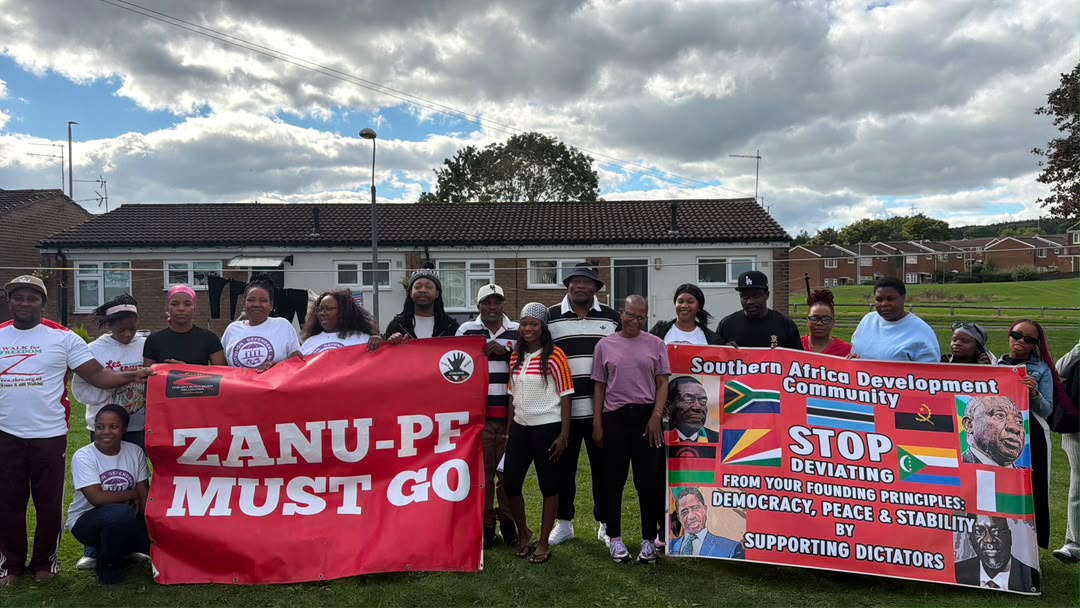
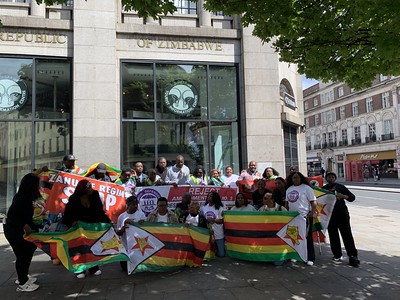
Three days after Emmerson Mnangagwa put his signature to the Constitution of Zimbabwe Amendment (No. 3) Act, the regime's embassy in London tried to sell investors on Zimbabwe. Outside, on the pavement, the diaspora explained why that pitch doesn't survive contact with the facts.
Two events, one address
Friday 10 July 2026 saw two things happen at 429 The Strand on the same afternoon, under the same roof, and neither made sense without the other.
Inside, the Zimbabwe Diaspora Business Forum – London, billed under the theme "Leveraging Diaspora Expertise for Sustainable Development" and fronted by the Financial Markets Indaba and CBZ Holdings, ran from 17:00 to 20:00. The invitation promised a "structured platform" connecting diaspora capital with Zimbabwe's "priority development projects."
Outside, the Constitution Defenders Forum (CDF), the Zimbabwe Human Rights Organisation (ZHRO), ROHR Zimbabwe and allied diaspora groups gathered under banners reading "ZANU-PF REGIME MUST GO" and "ZANU-PF REGIME STOP: ABDUCTIONS, ARBITRARY ARREST, PERSECUTION, CORRUPTION, POLICE BRUTALITY, HUMAN RIGHTS VIOLATIONS." A Metropolitan Police Liaison Officer stood by, as he has done at every one of these demonstrations outside the embassy over the past eighteen months.
- Details
- Written by: John Burke
- Hits: 231
 MANUFACTURED IMMUNITY
How Zimbabwe's “Patriotic Act” Was Drafted to Never Touch the Hands That Wield It
A ZHRO Briefing Note on CAB3, the Criminal Law (Codification and Reform) Amendment Act, 2023, and the Politics of One-Way Accountability
Zimbabwe's Criminal Law (Codification and Reform) Amendment Act, 2023 — universally known as the “Patriotic Act” — was sold to the nation as a shield for sovereignty. It criminalises any citizen who, in the state's judgement, “wilfully injures the sovereignty and national interest of Zimbabwe,” with penalties that until a 2025 High Court ruling included death, life imprisonment, loss of citizenship, and a five-year ban from voting or holding office. Its architects insisted it existed to protect the constitutional order from subversion.
Constitutional Amendment Bill No. 3 (CAB3) now gives that claim its sharpest test. If the Patriotic Act genuinely exists to protect Zimbabwe's constitutional order from those who would “subvert, upset, overthrow or overturn” it, then a bill advanced through a manufactured, coercive, and internationally condemned “consultation” process — one that strips fixed presidential term limits, concentrates judicial appointments in the executive, and weakens independent electoral oversight — ought to be the single clearest case the Act was written to catch. It is not. And the reason why is the argument.
I. A Law Built With Only One Door
Read the Patriotic Act closely and a structural fact emerges: it has no clause, no offence, and no mechanism capable of being turned against the state itself. Section 22A criminalises a citizen who meets or communicates with a foreign government “with the aim of subverting, upsetting, overthrowing or overturning the constitutional government in Zimbabwe.” It criminalises advocacy for sanctions. It criminalises participation in international forums that embarrass the state. Every verb in the statute points outward, from the citizen toward the state, or from the diaspora toward Harare. None of them point back.
This is not an oversight. It is the design. A law intended even-handedly to protect “the constitutional order” from subversion, regardless of who does the subverting, would need to contemplate the possibility that subversion could originate from within government — from a ruling party using its parliamentary majority to rewrite the constitution it swore to uphold. The Patriotic Act contemplates no such thing. It was never drafted as a neutral guardian of constitutional order. It was drafted as a weapon with a single grip, shaped to fit only the hand of the state, and only ever swung outward.
- The political capture
- Observer Report - CDF Meeting UK
- SPECIAL REPORT Democracy Under Siege
- Democracy Under Siege
- Justice, Democracy, and a Referendum
- The Ramaphosa Farm Visit
- Zimbabwe’s Cry for Freedom Cannot Be Ignored
- 21st April 2026 - Petition Delivered
- 18th April 2026 - CAB3 Protest
- You Shall Not PASS - CAB3
- Pixels of Propaganda
- ZHRO Proposes a Stronger Constitution