 Joint Statement & Call to Action
Standing Together for Zimbabwe's Democracy: Two Days, One Voice
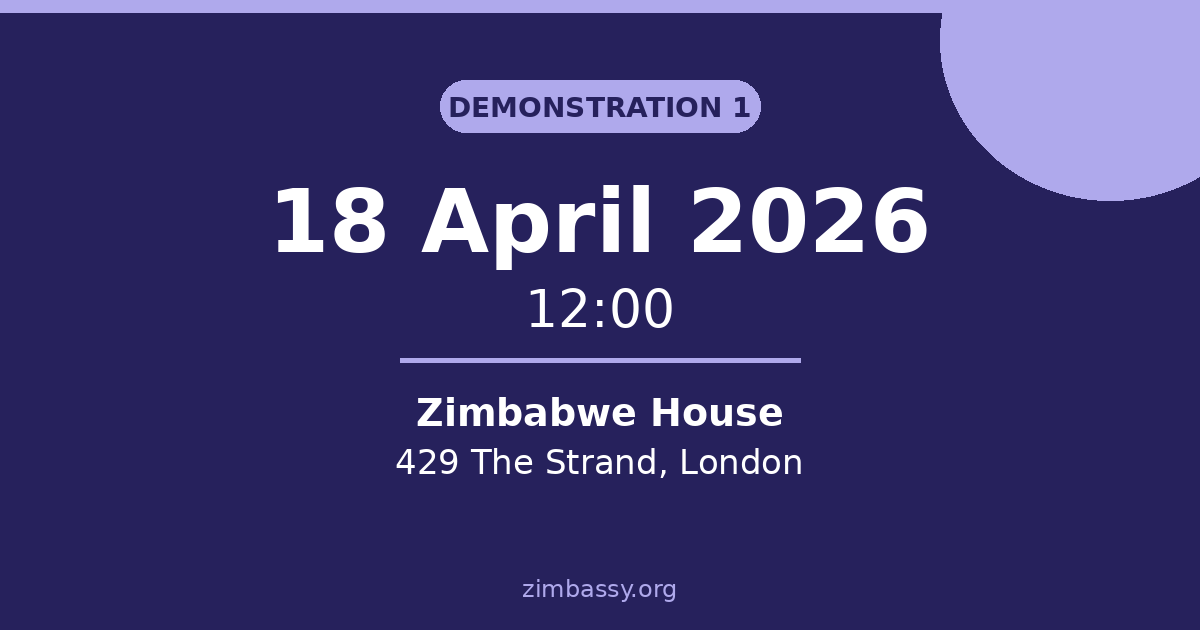
There are moments in the life of a people when history refuses to wait. 18 April 2026 is one of them. On the forty-sixth anniversary of Zimbabwe's independence — a day already freighted with meaning, sacrifice, and hope — Zimbabweans in the United Kingdom will take to the streets of London in a demonstration that carries the unmistakable weight of a second independence movement: not from colonial rule this time, but from the creeping authoritarianism that threatens to hollow out the constitutional democracy their forebears won.
At noon, outside Zimbabwe House at 429 The Strand — the symbolic seat of Zimbabwean state authority in London — demonstrators will gather in firm, peaceful, and unequivocal rejection of Constitutional Amendment Bill No. 3 (CAB 3). Three days later, on 21 April 2026 at 14:00, a formal written petition will be delivered directly to the UK Prime Minister and the Foreign, Commonwealth & Development Office (FCDO) — placing the diaspora's opposition before those with the standing to raise Zimbabwe's democratic crisis at the highest diplomatic levels.
These are not two isolated events. They are two movements of a single, sustained declaration: that the Zimbabwean people — at home and in the diaspora — will not stand silently as their constitution is rewritten against them.
Why CAB 3 cannot pass unchallenged
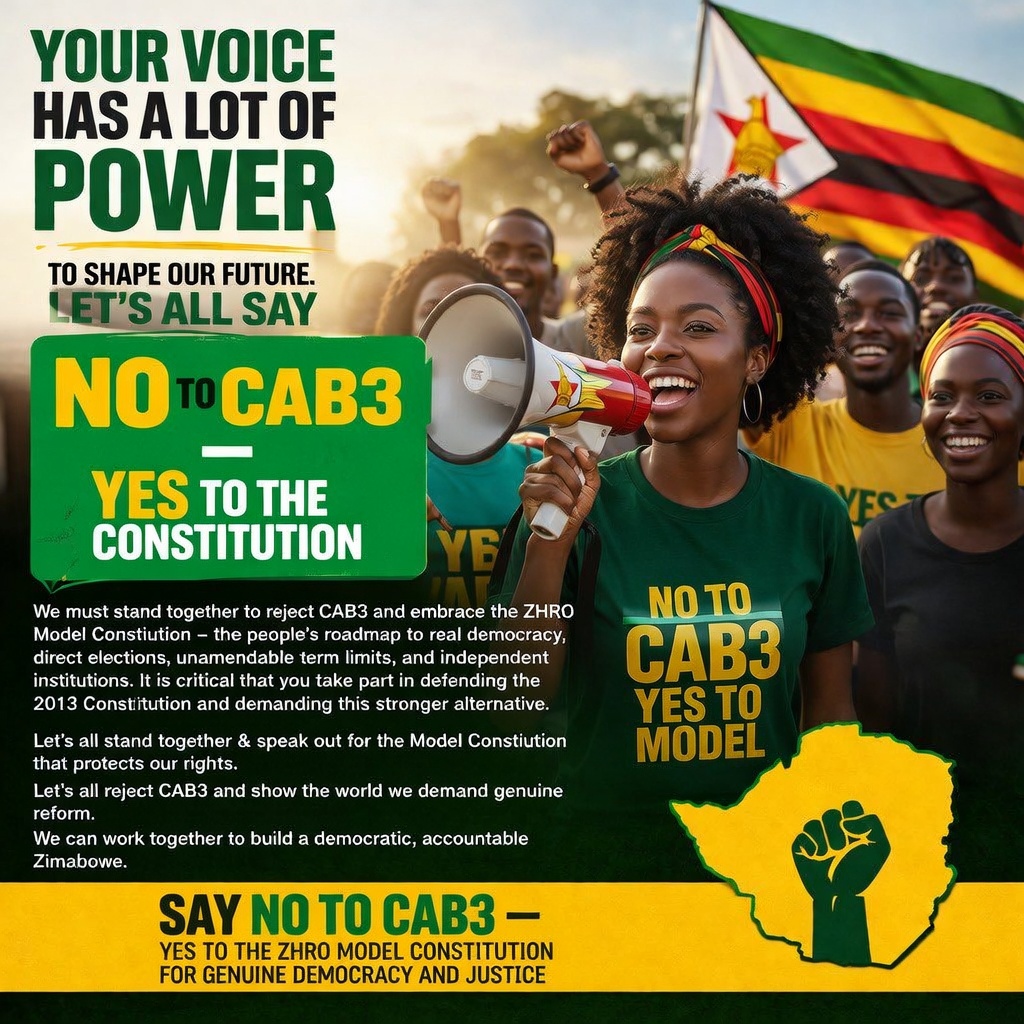
The organisers of the April 18 demonstration have made their position plain: they are completely against CAB 3. The proposed amendments, they argue, undermine the rule of law, weaken democratic institutions, and erode the rights of ordinary citizens. "This is not just a policy disagreement," one organiser has said. "It is about safeguarding the fundamental principles of democracy. CAB 3 represents a dangerous shift that must be resisted."
The banners will read "Zanu PF Must Go" and "Zanu PF regime STOP ......." — not the language of faction or party, but of principle. Participants describe the march as a peaceful but firm stand against governance changes they believe could consolidate power and reduce accountability; what many are calling, without hesitation, "constitutional backsliding."
The protest call has spread widely across social media, drawing together Zimbabweans and allies who understand that to remain silent in the face of such changes is itself a political act — and the wrong one. Many in the diaspora feel the particular responsibility of those who are free to speak on behalf of those who, within Zimbabwe, may not be.
From the streets to the seat of government
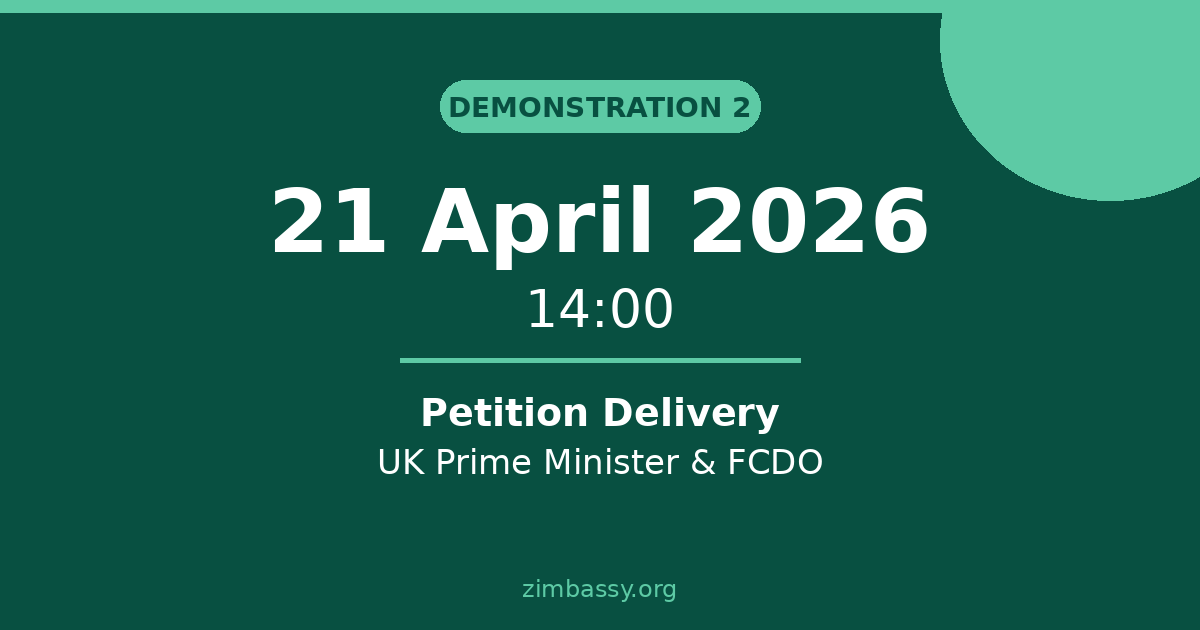 The April 21 petition delivery does not repeat what the demonstration says — it extends it. Where April 18 is an act of collective witness, visible and audible and impossible to ignore, April 21 is an act of formal accountability: a written record, lodged with the UK Government, that the Zimbabwean diaspora has spoken and expects to be heard.
The demonstration gives the petition its moral authority. The petition gives the demonstration its political consequence. Neither is fully sufficient alone; together, they form a complete and deliberate arc — from public mobilisation to institutional engagement — that reflects the maturity and seriousness of this movement.
A new chapter begins on independence day
It is no coincidence that April 18 was chosen. Independence Day has always been, for Zimbabweans, a day of reckoning with the distance between what was promised and what has been delivered. This year, a new chapter opens quietly alongside the demonstration — one that will make itself more fully known in the days ahead, and that already carries a name worth watching: ZIMBASSY!
Think of it as a seed planted on independence soil. Its purpose is to give the diaspora a permanent, growing platform — for advocacy, for news, for community, for memory. The events of April 18 and April 21 are among its first stories. They will not be the last.
A peaceful stand with a clear message
 Both demonstrations are entirely peaceful — and that matters. A peaceful, organised, legally conducted protest and petition is not the soft option; it is the fullest expression of the very democratic values that CAB 3 threatens. The diaspora does not need to mirror authoritarianism to resist it. Transparency, accountability, and respect for constitutional norms are the instruments being brought to bear here — and in the long run, they are the most powerful ones of all.
The April 18 demonstration is expected to highlight the growing alarm felt by Zimbabweans globally. The April 21 petition will place that alarm on the record. And something that begins its life on independence day will carry both forward — quietly, persistently, and with purpose.
John Burke is the Chair of ZHRO Ltd. Rumbidzai Thelma Chidewu is a new member who has also enlisted her family into ZHRO. Both are advocates for democratic governance in Zimbabwe and members of the Zimbabwean diaspora community in the United Kingdom.