
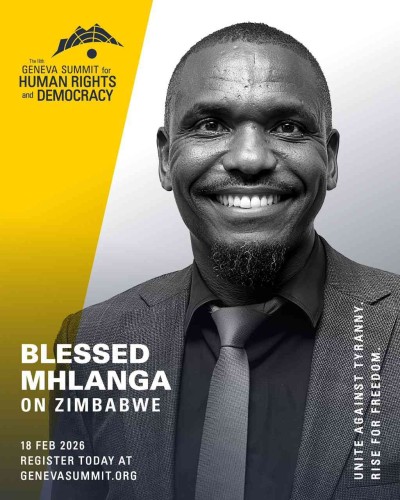
 Senator Tshabangu's Threat Against Journalist Blessed Mhlanga
— February 2026
The Trigger: A Speech in Geneva
The immediate incident centres on journalist Blessed Mhlanga, a prominent digital editor and head of broadcasting for Alpha Media Holdings (AMH). Mhlanga participated as a panellist at the Geneva Summit for Human Rights and Democracy on 18 February 2026, where he delivered a scathing critique of the Zimbabwean government's human rights record and its systematic suppression of media freedom. My Zimbabwe News
In his speech, Mhlanga described Zimbabwe as a tyrannical state, saying: "This is the new face of repression in Zimbabwe, laced with sophistication. In the past, it was naked violence on the streets, abductions and forced disappearances. It has changed — it is now violence committed through the legal system, what I call 'lawfare'." Bulawayo24
Tshabangu's Threat
The response from Senator Tshabangu was swift and striking. Posting on X (formerly Twitter), Tshabangu labelled Mhlanga "unpatriotic" and wrote: "I listened to @bbmhlanga speaking at the Geneva Summit, and I was deeply moved by his remarks. As an opposition politician and a Senator in the Parliament of Zimbabwe, I will raise a motion in the Senate urging the Government to cancel his passport. Patriotism must be upheld."
Bulawayo24
This was notable because Tshabangu is nominally an opposition figure — the self-declared interim secretary-general of the Citizens Coalition for Change (CCC) — yet his threat aligned squarely with the ruling ZANU-PF government's response.
The Government Piles On
Tshabangu was not alone. After Mhlanga testified about repression and restrictions on media freedom, the state-owned newspaper The Herald published a statement by Information Minister Zhemu Soda condemning his remarks as "malicious" and warning that Zimbabwe's so-called "patriotic clauses" prohibit engagement with foreign entities in ways deemed harmful to the state. UN Watch
The Zimbabwe Republic Police's Law and Order section reportedly launched a high-powered operation to apprehend Mhlanga, My Zimbabwe News and according to media reports, counterintelligence teams were deployed to the airport as if he were a high-level security threat. Thezimbabwean
International Condemnation
The international response was swift. On 20 February 2026, the Geneva Summit for Human Rights and Democracy coalition called on the United Nations to take urgent action, and the coalition formally lodged a complaint with UN Secretary-General António Guterres. UN Watch Hillel Neuer, Executive Director of UN Watch, stated: "These are not abstract criticisms — they are threats of prosecution and restrictions on freedom of movement in retaliation for speaking at the United Nations," adding that "No journalist or human rights defender should face criminal charges or passport revocation for cooperating with the UN." My Zimbabwe News
Gladys Kajawo Reports - 20th February 2026
Recent remarks by Senator Sengezo Tshabangu threatening possible action against journalist Blessed Mhlanga have sparked more than a passing political controversy. They have reopened an enduring national debate about the strength — or fragility — of constitutional protections in Zimbabwe. At stake is not merely a disagreement between a politician and a journalist, but the credibility of the rule of law itself. In any democracy, words spoken by public officials carry institutional weight. When a senior political figure suggests that a citizen’s passport or legal standing could be affected by speech delivered abroad, the implication extends far beyond personal criticism. Such statements risk creating the impression that political authority may reach beyond constitutional limits — an impression that undermines public confidence in independent governance.
Zimbabwe’s Constitution guarantees freedom of expression and freedom of movement as fundamental rights. These protections exist precisely to shield citizens — including journalists — from retaliation linked to political speech. They are not privileges granted at the discretion of officeholders but legal safeguards meant to ensure equality before the law.
When political rhetoric appears to challenge these principles, even indirectly, it raises uncomfortable questions about whether institutions remain insulated from political pressure. The real danger is not necessarily that threats will be carried out. Democracies often face heated rhetoric without descending into authoritarian practice. The deeper concern lies in the normalisation of language that suggests power can influence legal outcomes. Over time, repeated signals of this nature erode trust in institutions more effectively than any single unlawful act.
Journalists occupy a uniquely sensitive position in this equation. Their role is to question authority, scrutinise decisions, and give voice to public concerns — often in uncomfortable ways. If criticism of political leadership begins to carry perceived personal risk, self-censorship becomes inevitable. A press that fears consequences cannot perform its democratic function, and a democracy without fearless journalism risks becoming accountable only in theory.
This moment also carries broader implications beyond domestic politics. Zimbabwe continues efforts to rebuild international confidence and demonstrate commitment to democratic norms. Political disputes that appear to blur the separation between state power and individual rights risk reinforcing longstanding external scepticism. In an interconnected world, governance perceptions influence investment, diplomacy, and national credibility. Supporters of strong political responses may argue that national reputation must be defended against criticism. Yet democratic maturity is measured not by how leaders respond to praise,
but by how they tolerate dissent. The rule of law demands restraint — an understanding that criticism, even harsh criticism, is not a threat to the state but an essential feature of open governance.
What ultimately matters is public trust. Citizens must believe that courts, administrative bodies, and state institutions operate independently of political personalities. Once people begin to suspect that legal protections depend on political alignment, constitutional guarantees lose their practical meaning. The controversy surrounding Tshabangu’s remarks should therefore serve as a moment of reflection rather than escalation. Political leaders bear a responsibility not only to uphold the law but to be seen upholding it. Language that implies otherwise risks weakening the very institutions leaders are sworn to protect.
Zimbabwe’s democratic future will not be defined solely by elections or constitutional texts, but by everyday respect for institutional boundaries. The rule of law survives when power accepts limits — especially when it has the ability to test them. A democracy is strongest not when critics are silenced, but when they speak freely without fear that authority may stand above the law