
 ZIMBABWEANS- EXPRESS SUPPORT FOR ELECTIONS, "CONCERN OVER PROCESS!
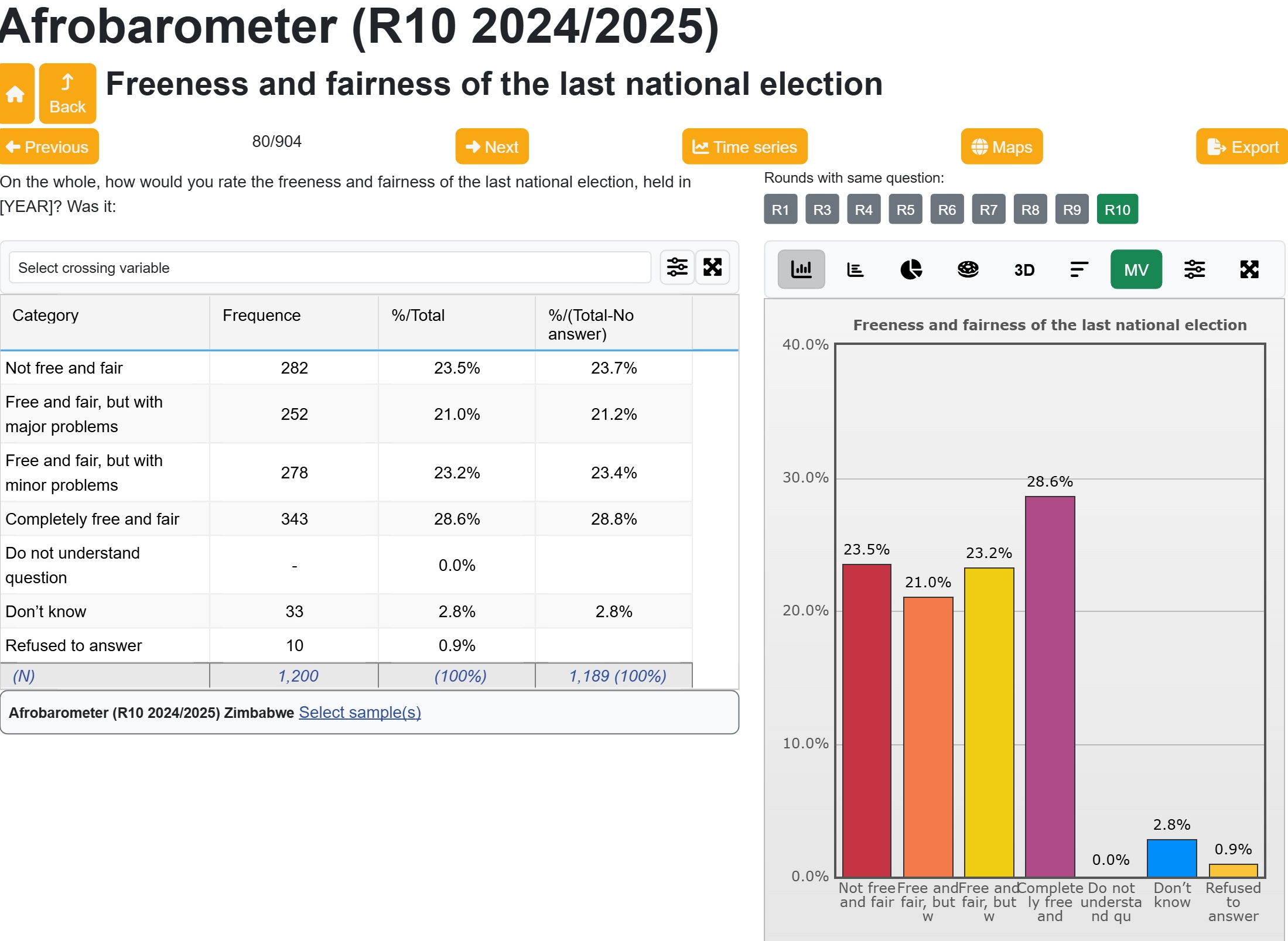
- A slim majority (52%) of Zimbabweans rate the 2023 elections as completely free and fair or free and fair with minor problems.
- 76% of citizens say they are free to choose whom to vote for without feeling pressured, up from 65% in 2009.
- Fear of political intimidation or violence during election campaigns declined sharply over the same period, from 83% to 31%.
All the above 'findings' have a lot of contradictions - considering the known issues within the Zimbabwe Electoral paradigm
And most likely due to the tiny data set of 1,200 respondents, something relatively easy to rig - just like the elections (see external opinions on this aspect below) - see image [Also click on the image to see a larger file with easier to read information]
- The 2023 Zimbabwean elections were marred by electoral fraud, manipulations and disinformation, they were rigged!
- The intimidation and violence (psychological and coercive) unleashed on the citizens of Zimbabwe during and after the 2023 elections, mainly in rural Zimbabwe is still going on.
- There was voter suppression by denying the right to vote in the 2023 election particularly in Harare and Bulawayo where ballot papers were systematically not delivered.
- There was also the midnight voting, and midnight printing of ballot papers.
- Zimbabwe Electoral Commission, (ZEC) failed to pass the confidence and credibility test. SADC Elections Observer Mission Final Report on Zimbabwe 2023 elections said it like it is.
- There is nothing being done on the recommended resolutions.
- The ZANU PF government side stepped the report and is continuing to use the stolen power, as if they have a full mandate from the citizens.
THE 2025 HUMAN RIGHTS DAY!
Zimbabwe Peace Project (ZPP), released a press statement on the 10th December 2025.
- In the year 2025 alone Zimbabwe Peace Project has documented 1235 human rights violations affecting 44,853 people across the country.
- These are mostly reports of abductions, torture, disappearance and inhuman treatment remain deeply concerning.
- The Afrobarometer report is sounding fine tuned to fit the ZANU PF regime's agenda E D 2030.
- As citizens in search of peace, freedom and happiness we remain focused, we will get there.
ZHRO have looked at the Data Set and the Regime
The 1,200 respondents is hardly a statistically significant data set - and certaily something that would be easily manipulated by a corrupt regime looking to portray itself as a democracy! In fact so typical of the Zanu PF regime to carefully manage its external perceptions - typically via such spokes-persons as Nick Mangwana - perversely a UK passport holder himself!
We asked GROK (X AI offering) the following sensibly framed question:
In Zimbabwe, the ruling regime (of now over 45 years) appears to go to great lengths to "manage" its external perceptions via disinformation - personified by spokes-persons like Nick Mangwana - who strangely holds a British Passport! What evidence is there of such manipulation that can be found from the many international commentators and other embassy staff from other nations to support this contention?
GROK did a very compelling deep dive search to produce its reply as shown below:
The Zimbabwean government, under the long-ruling ZANU-PF party, has indeed engaged in systematic efforts to shape external perceptions through disinformation and propaganda, often amplified via state media, social platforms, and official spokespersons like Nick Mangwana, the Permanent Secretary for Information, Publicity and Broadcasting Services. Mangwana, who holds dual Zimbabwean-British citizenship (including a British passport acquired in the 1990s while living in the UK), has been a central figure in these efforts, using his X (formerly Twitter) account (@nickmangwana) to defend regime actions, justify elite wealth accumulation, and counter critical narratives. This has drawn scrutiny from international observers, fact-checkers, and diplomatic channels, who highlight how such tactics undermine Zimbabwe's credibility, particularly around elections, human rights, and economic claims.
Key Evidence from International Reports and Observers International organizations and media have documented ZANU-PF's use of disinformation to discredit critics, including foreign entities, while portraying the regime positively abroad. These efforts often involve coordinated online campaigns, manipulated media, and state amplification to deflect from domestic failures like corruption, electoral irregularities, and economic mismanagement.
- Discrediting International Election Observers (2023 Elections): During the August 2023 general elections, ZANU-PF and state media launched disinformation campaigns targeting missions from the Southern African Development Community (SADC), European Union (EU), and Carter Center. False narratives accused observers of bribery (e.g., claims the EU offered journalists whiskey and vouchers) and bias, amplified via bots, varakashi (pro-regime online trolls), and state outlets. SADC's observer mission head, Nevers Mumba, faced coordinated X attacks labeling him a "regime change agent." The EU publicly denounced these as attempts to "undermine independent monitoring," while the Carter Center's report noted the campaigns eroded trust in Zimbabwe's electoral process globally. Freedom House rated these efforts as a key factor in declining internet freedom, contributing to a broader international view of Zimbabwe as an authoritarian state suppressing dissent.
- Propaganda on Social Media and Digital Platforms: A Global Voices investigation detailed how the regime dominates online discourse through "hybrid technology-driven warfare," including fake news and inauthentic behavior to justify actions like nepotistic appointments (e.g., Mangwana defended the hiring of Vice President Kembo Mohadi's daughter to the Zimbabwe Electoral Commission as "equal opportunities"). This has led to democratic regression, with international experts like Clare Muhindo (African Centre for Media Excellence) describing it as "patently false information deliberately peddled to cause harm," exacerbated by unregulated platforms. Zoe Titus (Namibia Media Trust) emphasized that such propaganda sways public opinion to consolidate authoritarian rule, influencing global perceptions of Zimbabwe as a polarized, information-war zone.
- Economic and Corruption Narratives: Al Jazeera's "Gold Mafia" documentary series (2023) exposed regime-linked gold smuggling and money laundering, filmed undercover over two years, prompting state denials and counter-narratives via Mangwana's X account. International fact-checkers, including those cited in Freedom House reports, debunked regime claims of economic recovery (e.g., fake images of "bumper harvests" amid food insecurity affecting tens of thousands). These distortions have fueled skepticism from bodies like the International Monetary Fund (IMF), which delayed aid in 2023-2024 due to unaddressed corruption, reinforcing views of Zimbabwe as a kleptocratic state.
Diplomatic and Embassy Staff PerspectivesEmbassy officials from Western nations have directly called out these tactics, often in response to regime accusations of foreign meddling. While direct leaks from embassy staff are limited (due to diplomatic norms), public statements and incidents provide clear evidence:
- US Embassy Summoning (2020): Zimbabwe's Foreign Ministry summoned US Ambassador Brian Nichols after White House National Security Adviser Robert O’Brien accused Harare (and China) of using social media to stoke US unrest post-George Floyd protests—without evidence. Mangwana rejected this as "adversarial," but the incident highlighted mutual disinformation claims. US diplomats have since reiterated concerns over ZANU-PF's "online narratives" targeting observers, with the State Department noting in 2024 reports that such tactics aim to "confuse and overwhelm" global audiences about Zimbabwe's human rights abuses.
- EU and SADC Diplomatic Rebukes: EU ambassadors in Harare issued a 2023 joint statement condemning ZANU-PF's "false accusations" against their election mission as propaganda to deflect from vote-rigging. SADC diplomats, in post-election briefings, described state media's role in spreading "misinformation" as a violation of regional democratic guidelines, eroding Zimbabwe's standing in the bloc. A 2024 Swedish Embassy statement addressed regime-linked media inaccuracies on aid, calling it "misinformation to the public."
- Broader Diplomatic Commentary: In a 2021 UK Parliament debate, British MPs (including those with Zimbabwean ties) labeled sanctions a "propaganda tool" exploited by ZANU-PF to blame external forces for internal graft, echoing US Embassy cables (leaked via WikiLeaks) from the 2000s-2010s that described Mangwana's predecessors as "spin doctors" fabricating narratives for foreign audiences.
Role of Nick Mangwana in External Manipulation
Mangwana's X activity (over 1 million followers) exemplifies personified disinformation: A 2024 academic analysis of his posts found them rife with "government propaganda, misinformation, and disinformation," including defenses of elite wealth ("ill-gotten" gains as "equal opportunities") and attacks on critics as "Western puppets." International journalists, like those from Al Jazeera and France 24, have profiled him as a key vector for election fake news (e.g., doctored crowd photos on WhatsApp). His British passport adds irony, as UK observers (e.g., in 2023 Commons reports) note it allows him to engage Western media while shielding regime narratives.
|
Aspect |
Regime Tactic |
International Response/Evidence |
|---|---|---|
|
Election Disinformation |
Fake bribery claims vs. EU/SADC observers |
EU statement: "Undermines monitoring"; SADC report: Media bias violates guidelines freedomhouse.org |
|
Social Media Propaganda |
Varakashi bots, Mangwana's X defenses |
Global Voices: "Information war threatens expression" advox.globalvoices.org ; Namibia Media Trust: Calls for platform regulation |
|
Diplomatic Incidents |
Summoning US envoy over "disinfo" claims |
Al Jazeera: Highlights tense US-Zim ties aljazeera.com ; US State Dept: Notes regime's "confuse and overwhelm" strategy spectrumlocalnews.com |
|
Economic Lies |
Fake harvest images, sanction scapegoating |
Freedom House: Debunked via fact-checkers; IMF aid delays |
These patterns, substantiated by NGOs like Freedom House and Amnesty International, portray a regime prioritizing narrative control over reform, alienating global partners and perpetuating isolation. While ZANU-PF claims opposition "fake news" mirrors their tactics, evidence overwhelmingly points to state orchestration for external image management.